|
 |
Sabah, Malaysian Borneo - Ecological Hot Spot |
|
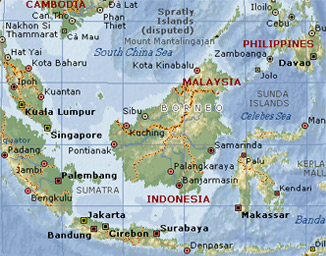
The great island of Borneo, situated in the South China Sea, is the third largest island in the world, and not that long ago was home to some of the oldest rainforest and supported some of the richest biodiversity on Earth. But today Borneo is also home to rampant ecological destruction. Straddling the equator, Borneo is a major part of the internationally recognized biodiversity hotspot known as the Sundaland hotspot. This area, which includes the Indonesian islands of Java and Sumatra, is exceptionally rich in both flora and fauna, and massively threatened by human neglect and exploitation.
Borneo is split by the international boundaries of Indonesia (Kalimantan), the sultanate of Brunei and the Malaysian states of Sabah and Sarawak, and although some areas of unexplored forest still exist, it has been relentlessly exploited by local and multinational logging, mining and palm oil corporations.
Every year, millions of hectares of rainforest are destroyed. If the current rate of deforestation in Borneo continues, the island could lose most of its lowland forests in less than ten years, according to a WWF report. Today, only half of Borneo’s forest cover remains, down from 75 per cent in the mid 1980s.
Destruction of rainforest means destruction of habitat and Borneo is home to many species not found anywhere else in the world. One such endemic species is the Bornean Orang Utan. According to one report, by 2020, the remaining populations of Orang Utans may be too small to be genetically viable due to fragmentation of their habitat.
Though some reserves exist, huge sections of rainforest, millions of hectares, lay unprotected and unmanaged in the hands of private individuals or corporations, or indifferent or under-funded governmental agencies.
|
|
|
|
Sabah, Malaysia |
|
In Sabah - the Malaysian state at the northern tip of Borneo - one significant area where a daily battle between conservation and destruction occurs is along the floodplain of the Kinabatangan river. At over 560 km long, the Kinabatangan serves as habitat to 10 species of primates, including the Orang Utan and Proboscis Monkey, and at least 200 species of birds. The Kinabatangan is also the crucial grazing route of the Borneo Pygmy Elephant and the lifeline for villages of the “Orang Sungai” or “people of the river”.
Though much of the Kinabatangan floodplain was once intended by the Sabah government to be preserved, a truly integral sanctuary never materialized. Pockets of forest were set aside but no link between these tracts was enforced - depriving animals’ access to necessary grazing territories. In addition, oil-palm plantations have expanded to almost every available hectare - rigorously protecting their boundaries against both Elephant and Orang Utan. The Malaysian palm oil industry, as the world’s number two supplier after Indonesia, is gearing up for an increase in yield and Sabah is targeted for much of this expansion, implying the further opening up of forests and the inevitable destruction of ecosystems.
And yet today, small pockets of resistance to this destruction are beginning to emerge in Sabah. In the face of poverty, greed and the crush of oil-palm monoculture, scientists, indigenous peoples and international NGO’s are working (sometimes together and sometimes in isolation without funding) to protect habitat and to establish a model of sustainable forest management.
Sabah is fortunate to have a fairly sound infrastructure in its economy, security and institutions such as the Forestry Department and Ministry of Tourism, Culture and Environment. And in contrast with Kalimantan (Indonesian Borneo), Sabah has a much more likely chance of success in reversing the trend of deforestation and habitat destruction and establishing a viable model of a sustainable relationship between humans and their environment. |
|
|
|
Untitled Document

|
|
|
|
visual3_a
Google AJAX Feed API - AJAX Slide Show Sample
|