|
 |
|
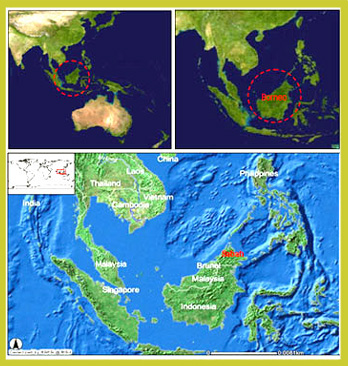
Sitting at the northern tip of Borneo, Sabah is the second largest state in Malaysia after Sarawak, and covers about 73,370 sq km, or about 10% of Borneo’s land mass. It has the longest coastline of any Malaysian state, some 1,440km, and extensive mangroves fringe the tropical seas. Inland are lowland dipterocarp rainforests, the richest in terms of species diversity including Borneo’s famous timber trees, peat swamp forests, rare heath forests growing on sandy soils, montane forests and small pockets of cloud forest growing mainly on Malaysia’s two highest peaks – Mount Kinabalu and Trus Madi. Sabah’s most iconic landmark, Mount Kinabalu is a massive granite mountain which at 4,095m above sea level is the loftiest peak between Myanmar and New Guinea.
Known to the world as ‘Land Below the Wind’, Sabah is rich not only in natural beauty and resources, but also in the cultural heritage of its people. |
|
FLORA & FAUNA
|
|
Sabah is a botanical paradise. Found here are three species of Rafflesia (bizarre parasitic plants, one species of which is the largest known flower in the world), and a spectacular proliferation of orchids, rhododendrons and pitcher plants, many of which are endemic to Sabah.
The rugged terrain with its mighty rivers and rich jungle provides home for wildlife such as the Critically Endangered Sumatran Rhino, the Endangered Orang Utan, the Borneo Pygmy Elephant and the endemic Proboscis Monkey, as well as Clouded Leopards, Sun Bears, Banteng, over 300 species of birds and many more rare and exotic creatures.
Natural forests cover about half of Sabah, including protected areas such as Forest Reserves, Conservation Areas and State Parks, as well as Commercial Forest Reserves which have been designated for selective logging. Over 1.3 million hectares or 18% of Sabah’s land mass has been converted to oil palm plantations, the largest area of any state in Malaysia, mostly in the flat, fertile land in the east of Sabah, and it is this conversion of natural forest habitat, leaving a landscape of fragmented and degraded forest patches, which poses the greatest threat to Sabah’s wildlife today.
Also well-known for its marine biodiversity, Sabah is washed by the South China Sea in the west, the Sulu Sea in the northeast and the Sulawesi Sea in the southeast and boasts some of the greatest coral diversity in the world. Overfishing, cyanide and fish-bombing and pollution from land-based activities are the major issues facing Sabah’s seas.
SABAH‘S PEOPLE & HISTORY
|
Sabah is also endowed with a heterogeneous human population. The indigenous population is made up of some 30 groups using more than 50 indigenous languages and no less than 80 dialects.
The non-Malay main ethnic groups are: the Dusun/Kadazan - the largest group who make up nearly one third of the population, the Murut, the Paitan and the Bajau. Other indigenous groups include the Bonggi, the Iranun, the Ida’an and the Brunei. In addition, the Chinese make up the main non-indigenous group. Therefore, the people of Sabah are varied in their respective cultural backgrounds.
|
|
|
|
Based on archaeological findings, Sabah was inhabited by people from as early as 28,000 years ago. Islam came to Sabah towards the end of the 15 and 16 centuries through the Arab and Indian traders and also as a result of the expansion of the Sulu and Brunei Malay Sultanates.
It was another two centuries more before the Europeans came to Sabah. In 1775, the British East-India Company opened a trading base in Balembangan Island. However, it was the British North Borneo Chartered Company who effectively ruled Sabah from 1881 until 1942 when the Japanese occupied the state. After the devastation of the War, Sabah became a British Crown Colony until 31 August 1963 when it obtained self-government from the British. On 16 September 1963, Sabah together with Sarawak, Singapore and Malaya joined the Federation of Malaysia.
Originally sparsely populated by small rural communities in the interior valleys and along the coast, the majority of Sabah’s estimated 3 million-plus population now live in the fast-growing coastal conurbations of Kota Kinabalu, Sandakan, Tawau, Lahad Datu, Semporna and Kudat.
|
|
|
|
|
Source: Sabah’s Heritage: A Brief Introduction to Sabah’s History
& History, Sabah Museum, Kota Kinabalu, 1992.
|
|
|
Untitled Document

|
|
|
visual3_a
Google AJAX Feed API - AJAX Slide Show Sample
|