The LEAP website is being updated. What follows is a message from LEAP Executive Director, Cynthia Ong.
I gave a presentation to 20 biology students a couple of weeks ago. In our work of facilitating partnerships and projects, we seek to first build common ground with those whom we engage. In this case, it was 20 super bright, motivated young people from the U.S. and all over the world on the Harvard University's Borneo Biodiversity course – 5 weeks in Borneo, visiting biodiversity hotspots and listening to and learning with people doing the work. I told them that I did not have a scientific bone in my body and that the common ground I could find upon which to connect with them was the spiral – the golden ratio, phi, the Fibonacci sequence, the science of nature. It is in the nautilus, the eye of a hurricane, the middle of a sunflower … biology, art, architecture, music …
 Adolf Zeising, a German psychologist whose interests were mathematics and philosophy, found the golden ratio expressed in the arrangement of branches along the stems of plants and of veins in leaves. He extended his research to the skeletons of animals and the branching of their veins and nerves, to the proportions of chemical compounds and the geometry of crystals, even to the use of proportion in art. Zeising wrote in 1854: "The Golden Ratio is a universal law in which is contained the ground-principle of all formative striving for beauty and completeness in the realms of both nature and art, and which permeates, as a paramount spiritual ideal, all structures, forms and proportions, whether cosmic or individual, organic or inorganic, acoustic or optical; which finds its fullest realization, however, in the human form."
I don't know if I agree with the bit about the fullest realization being in the human form (are we humans self-centered or what?!), but yes, the Golden Ratio is everywhere EVEN in us humans (think Leonardo Da Vinci and Vetruvian Man). Someone else said "the golden ratio expresses movement because it keeps on spiraling to infinity". I like that.
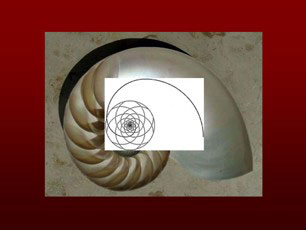 It says somewhere on our website "The spiral is crucial, for in it the captivity of the sheer circle is broken, penetrated by the linear movement of historical time, while time is relieved of its burden and its homelessness. Where and when the two meet 'there is a whirlpool' and then a transformation wherein spiral is created, maintaining yet liberating the circle and the line." "Not only does the spiral include history in its sweep, but it also encompasses biology, even allowing for the theory of evolution. Just as a cart, one with innumerable wheels perhaps, slowly moves forward in a straight line, so the process of evolution is simultaneously cyclic and linear. Cirlot's dictionary states that the spiral is in fact "A schematic image of the evolution of the universe." It is no coincidence, then, that the term evolution (e- "out" + volvere "to roll") means "to unroll" or "to open outward"– the precise motion of the spiral."
The spiral, as a paramount spiritual AND practical ideal, permeates LEAP's founding and continued work. It is what has inspired and guided our work and continues to do so. Going back to my presentation, I went on to say that in the spirit of the spiral, the best way for me to talk about LEAP and its work is to "spiral inward" a month and share what unfolded in terms of "facilitating projects, partnerships and exchanges" in that space-time continuum.
We have been MIA in updating this website over the past months, and for that I sincerely apologize. We have no excuses except to say that we have all had our heads pretty close to the ground, dealing with the day to day realities, challenges and demands of the unfolding and growing of our work. In organizational speak, Capacity Building … and that capacity never did stretch to encompass website updating! So, in my not knowing where to start, I will spiral back a month and share some stories, and hope we will be forgiven.
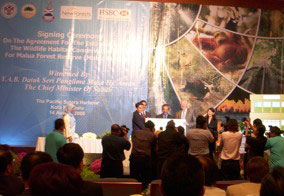 August 14, 2008 saw the launch of the Malua Bio Bank www.maluabiobank.com witnessed by a few hundred people from the worlds of conservation, business and government, including the Chief Minister of Sabah. It was a proud moment for Sabah, as trail blazers of the first voluntary biodiversity credit project in the world. It was a gratifying moment for us too, having played a role in the initiation of the project – helping facilitate relationships and identifying Malua as a strategic area for the project. LEAP will continue our engagement through my role on the Advisory Committee. The photo below shows the state of Sabah receiving $10 million for the Malua Trust which will fund the implementation of the conservation management plan over the next 6 years. This will include habitat restoration, wildlife monitoring and evaluation, community engagement, etc. Please visit the website to learn more about this exciting endeavor and see how you can buy Biodiversity Conservation Certificates, with each certificate representing 100-square meters of rainforest restoration and protection.
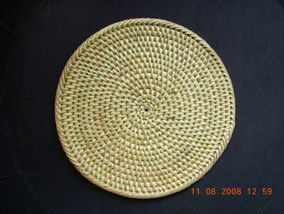 On August 9, 2008, I had the honor of celebrating International Day of the World's Indigenous Peoples with our partners PACOS, some of the women leaders from PWET (Project Women Empowerment Trees), and other indigenous communities from throughout the state. It was good to take a moment to celebrate the achievements of the year and the people who lead the way and follow through every step of the way, acknowledge the continued challenges AND re-energize for the journey ahead. We danced, sang, ate, drank - gathered as one and built community amongst each other. To my disappointment, I missed the Bobohizan (High Priestess) rituals in the early morning, where they circled around the leaders and prayed and prepared them for the journey forward in the way they prepared warriors in the old days. I did not miss the sale of lovely food and craft produce from the villages. I stopped by the stall where the Rungus women sold their crafts and picked up a coaster made of a type of grass. Here's a picture. Does the pattern look familiar?! It was a joyful moment in which to share with Raini, Yoggie, Hani and Junita from PWET and celebrate the journey of empowerment they have been on, also having just returned from Chiang Mai, Thailand and the regional celebrations of the United Nations Declaration on the Rights of Indigenous Peoples, where the PWET leaders not only represented their community, but the state and the nation. Learn more about the World's Indigenous Peoples Day from: www.un.org/depts/dhl/indigenous
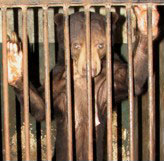 Bear Necessities. Sun Bear Necessities, to be more specific, is the Bornean Sun Bear Conservation Center (BSBCC), a partnership between the Sabah Wildlife Department, the Sabah Forestry Department and LEAP with Sun Bear scientist Wong Siew Te. The vision is to build this facility in Sepilok, Sandakan, adjacent to the world-renown Sepilok Orang Utan Rehabilitation Center. The increasing numbers of captive Sun Bears is an intensifying issue, caused by shrinking habitat as more forests are swallowed up by mono-culture plantations and human's insatiable hunger for tropical timbers. Sun bears are captured and kept as pets in cages they can hardly move in, or hunted for particular body parts used for medicinal or ornamental purposes. LEAP conceptualized the Bear Necessities fund raiser to be held on November 14, 2008, to raise at least half of the construction and operations budget from within Sabah and Malaysia. With full support from a line-up of the most respected Malaysian entertainers and the Chief Minister of Sabah, and the two hosting government departments, we are hopeful that the Sabah-Malaysian-international corporate and diplomatic circles will step up in partnership. Learn more about BSBCC and the plight of the Sun Bear: www.sunbears.wildlifedirect.org
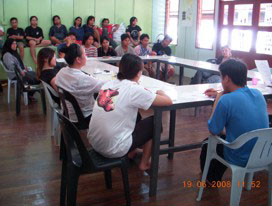 The Sumatran Rhino (whom we have taken to calling the Bornean Rhino here) is the most critically endangered species in Borneo. So critical that sightings are rare and real numbers are unknown. SOS Rhino U.S., after 10 years of rhino protection and conservation work in Sabah, folded their operations on June 30, 2008 and entrusted the management and operations of their team and work to SOS Rhino Borneo. LEAP helped facilitate the formation of the new board, which I now sit on with a group of power-house individuals – Dr. Junaidi Payne of WWF Malaysia, Dr. Isabelle Lackman of Hutan, Dr. Hamid Abdul Ahmad of the Institute of Tropical Biology and Conservation of the Universiti Malaysia Sabah. The last two months has seen us transitioning out from the old and transitioning in to the new, whilst working through core organizational issues. A team of 15 or so staff continues field operations in Tabin Wildlife Reserve (120,000 hectares) in the east coast of Sabah and administrative operations in a Kota Kinabalu office. The current focus is now in fund raising and organizational development. For more information: www.sosrhino.org/index.php
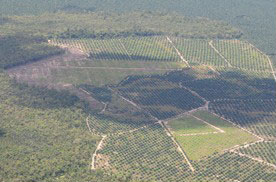 Over the past weeks, we facilitated the purchase of a very critical habitat corridor area in Sabah. This was in partnership with the World Land Trust www.worldlandtrust.org of U.K. and the Sabah Forestry Department. We are not at liberty to publicize details on this as the purchase is still in process, but more will be revealed in due course! Suffice it to say for now that this is one of our most exciting achievements to date – protecting and ensuring the perpetual contiguity of two tracts of forest reserves by purchasing a critical corridor that was on the verge of falling into the hands of agro-industry. In April this year, we began our engagement in earnest with the World Land Trust, when they visited Sabah and traveled to key issue areas for land acquisition. We then identified two first cases to work on in partnership, and within three short months, they were able to raise the funds needed for the first purchase. We are now working on the second case which we are hopeful will converge as successfully by the end of this year. www.worldlandtrust.org/projects/malaysia.htm
On July 17, 2008, some 80 people from the worlds of conservation, government and forestry gathered in Sandakan for a Workshop on Payment for Ecosystem Services (PES) with a focus on Forest Carbon. This was hosted by the Sabah Forestry Department, in association with Forest Trends www.forest-trends.org and Winrock International www.winrock.org and facilitated by LEAP. This is an area of work that LEAP has been working on for the past year – bridging the world of PES to Sabah. The purpose of the workshop was to begin building local capacity by creating a knowledge base of PES. A 3-day field trip followed – to Deramakot Forest Reserve, Ulu Segama Malua Forest Reserves and the Lower Kinabatangan Wildlife Sanctuary. We then had a closing discussion to explore potential project sites for analyses for pilot carbon projects. Three priority sites were identified for next steps – which would be PIN (Project Idea Note) development and then PDD (Project Design Document) development if deemed viable. The hope is that we can make PES work for Sabah as an alternative means of generating revenue through our forest resources.
So, there you have it. No linear processes, no circular processes, but many spiraling, interconnected processes – spiraling outward, spiraling inward, always in movement, always swirling chaos. Our work is about getting/being within the chaos and facilitating synergy, coherence and even harmony.
Please bear with us while we continue to update the site – especially in the project and photos area where we are quite fantastically out of date! When the updates are done, you will have the fuller story on each of these projects mentioned here and more.
Yours in the spiral,
Cynthia Ong
LEAP Malaysia • HC812, 8th Floor, Hawaii Court, Waikiki Condominium, Tanjung Aru, Kota Kinabalu 88100, Sabah, Malaysian Borneo • 6.088.270705
LEAP USA • 3378 Revere Avenue, Oakland, California 94605, U.S.A. • 310.429.2686
info@leapspiral.org
© Copyright 2008. All rights reserved.