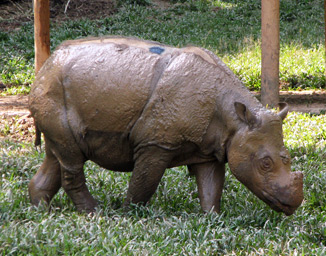
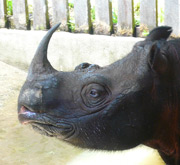
Sabah is home to one of the rarest mammals on earth, the Critically Endangered Sumatran rhino, with a world population of probably little more than 200 animals. Less than 40 of the sub-species found in Borneo, (Dicerorhinus sumatrensis harrissoni), are thought to survive, clinging on in pockets of forest in eastern and central Sabah. The two main populations, numbering perhaps 13-15 rhinos each, are in Danum Valley Conservation Area and Tabin Wildlife Reserve, with a few other isolated individuals scattered elsewhere.
Recognizing the urgency of this situation, a US-based NGO, SOS Rhino, came to Sabah in 2000 and actively assisted Sabah Wildlife Department in rhino protection in Tabin, and in 2003, established a local NGO, SOS Rhino Borneo (SOSRB), to provide protection for Tabin’s rhinos through patrolling, monitoring and community outreach. SOSRB then established a new, Sabah-based Board of Directors in 2008 and in early 2009 changed its name to Borneo Rhino Alliance or BORA.
LEAP helped facilitate this transition from a US NGO in Sabah to a Sabahan NGO, and Cynthia Ong joined BORA’s Board , along with Dr Junaidi Payne (BORA Executive Director), Dr Abdul Hamid Ahmad of the Institute for Tropical Biology and Conservation, Universiti Malaysia Sabah (Chairman), and Dr Isabelle Lackman of HUTAN.
BORA’s mission is to prevent the extinction of Sumatran Rhino in Borneo by protecting wild rhinos and bringing rhinos together in managed breeding facilities in Tabin. Its key roles are running field patrols (Rhino Protection Units or RPUs) to protect and monitor wild rhinos in the 122,000 hectare Tabin Wildlife Reserve, and helping to establish the Borneo Rhino Sanctuary (BRS) – a managed, fenced area inside Tabin Wildlife Reserve, where selected rhinos will be brought as a means to boost prospects for breeding and to reduce threats of poaching.
BORA works in close collaboration with Sabah Wildlife Department and other government agencies, as well as with NGOs and industry, both locally and internationally, LEAP is on the BRS Technical Committee, which gives recommendations on the development and implementation of BRS.
The first rhino for the programme was ‘Tam’, an adult male who was found wandering in an oil palm plantation near Tabin in August 2008. Tam was rescued and released into a 2.5 hectare enclosure of natural forest and adjoining night stall at Tabin, where he is cared for, fed and monitored. These and additional paddock and night stalls serve as interim facilities until the BRS is fully established, and have been funded by Sabah Forestry Department, Sabah Ministry of Tourism, Culture and Environment, Sime Darby Foundation and WWF Germany.
Indeed, substantial funding has come from Sime Darby Foundation, which has committed RM5 million ($1,560,000) over 3 years. Three new 4 wheel drive vehicles were donated in March 2010 as part of this grant, providing a much needed boost to field operations.
The BRS breeding facilities, located deeper inside Tabin Wildlife Reserve, will consist of 5 individual fenced paddocks covering a total of 20 hectares of natural forest, eight night stalls, two small breeding paddocks, stores, simple staff quarters and an access road, and will be funded mainly by government programmes, notably the Sabah Development Corridor Programme.
LEAP has also been actively involved in fundraising, earlier facilitating both a seed-grant for SOSRB operations from Alexander Abraham Foundation and Shared Earth Foundation, and Asian Rhino Project providing part-funding for one year of RPU operations. LEAP also helped to organize another groundbreaking conservation fundraising event, the ‘RHINO RESCUE LUNCH’ in Kota Kinabalu in March 2009. RM530,000 (about $15,000) was raised through a novel and interactive pledge-making process where pieces of a giant jigsaw of a rhino picture were ‘bought’ by donors, thus securing BORA operational funds for another year!
LEAP is proud to partner with BORA and work towards a brighter future for the Sumatran Rhino in Borneo.